Wednesday, August 21, 2013

25-word summaries


About 7 years ago I went to a workshop on literacy and learned a little instructional strategy that has been a go-to many times since: the 25-word summary. It’s as simple as it sounds, only it is not.

For me, it’s easy to ask this of my students, they, on the other hand, are regularly challenged by the strategy - and that is the point. To write an accurate and useful summary, regardless of the text being used, the students need to really understand the main idea/s. Not only that, they need to be creative with their writing and conscious of the exact words they do or do not use. There is no room for fluff within 25.

In today’s class, the students took the homework summary they wrote in response to an academic article, “Prisoners of Geography” about Robert Hausmann’s theory on the links between geography and economic development. In many cases the students’ original “summary” was more than a half-page, typed.  So when I said 25 words in the new summary, there was a collective gasp in the room.


The students worked together in groups of three, and it took some time. It was worth it because they were successful not only in staying within the word limit, but more importantly, 100% of the students shared that they understood the challenging content better as a result of the 25-word summary process.


Saturday, December 8, 2012

Collaboration


Collaboration is an essential element for successful teaching and a significant part of my repertoire. I regularly share with and learn from colleagues to ensure the best possible instruction for all students. My students also benefit from working alongside each other in meaningful ways. Besides day-to-day collaboration, I have embarked on occasional projects that go beyond the classroom to incorporate school and community.

"Befriending the Cloud" is a presentation I recently gave at the Google for Education Summit here in Bangkok. The purpose was to share with other educators the process and benefits of my students' recent exchange with University of Akron pre-service teachers, as described in earlier posts.


Here are some samples of other collaborations I have undertaken to benefit my students and include the wider community in our classroom learning: 
I'm always interested in collaboration opportunities, and learning about ways in which other educators go beyond the classroom, so please share your experiences and ideas.

Wednesday, November 7, 2012

So, What's Your Reaction?

Two of my Modern World History classes have been collaborating this semester with University of Akron pre-service teachers in Ohio. Besides sharing information and perceptions about their countries, cultures, and stereotypes, and having history content-related conversations, some of these students otherwise separated by distance and age found common interest discussing current events. Not surprisingly, the focus lately was on Hurricane Sandy and the U.S. Presidential election.

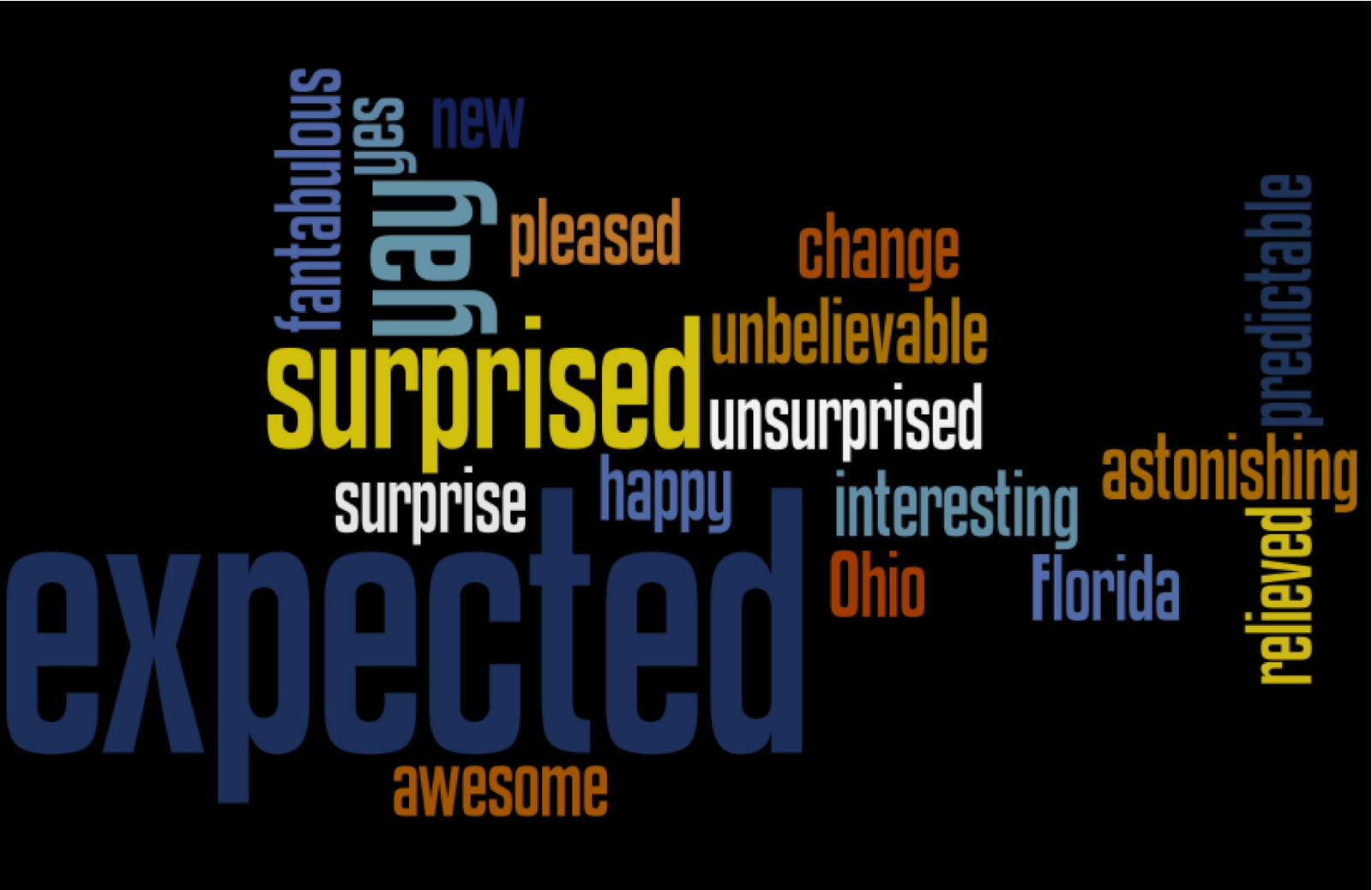
Today, I asked the international students in my class to provide a one-word reaction to the outcome of the election. Below is a Wordle with responses from 25 students:
(BTW, the red Ohio, and blue Florida colors were randomly assigned by the Wordle program.)
While I'm not entirely sure about the thinking behind "new" and "change" responses, all of the students were aware of the election's outcome and easily responded to the question. There were many emphatically positive reactions, while others were somewhat neutral. If students were disappointed, they did not share.

My students and I are curious about the reactions other students have had around the world to the election. Care to share?

Monday, October 22, 2012

What I Do


Dr. Brad Maguth of the University of Akron has asked pre-service teachers in his Social Studies Methodology class to prepare a lesson on Imperialism / Colonization / Industrialization in the US for my world history students, and in response to our semester-long collaboration. His students have been getting to know mine through informal correspondence, shared lessons, and Skype conversations.  The plan is for me to implement a lesson these teachers-in-training are developing, record aspects of it, and evaluate the lesson itself. The University class will also reflect on the lesson after watching the video.

Once Dr. Maguth's students were provided with the unit assessment I planned on giving my grade 10s, they knew where we were headed, which helped them design a lesson integrating their knowledge of the students in my classes, the curriculum we are following, and where the class was headed. There was still a gap though, so Dr. Maguth asked me about my teaching "style" and approach.

And at the end of a long day of teaching, I took a few minutes in an email to describe what I do.  Sure, there are holes, and it could benefit from further editing, but it got me thinking about how rarely we articulate our unique teaching styles, and wondering how transparent and honest are we to ourselves, and others, about what we do inside our classrooms day in and day out? 

Thus, in a bold moment, I decided to post the e-mail I sent to Dr. Maguth:

Dear Brad,

All of the daily agendas and related docs for my 10th grade world history course can be found on our class website. Thankfully, I am not required to write up every lesson plan, though I do create an agenda for every class as part of my own professional practice, and to foster student independence during absences, etc. Your students will hopefully be able to read through the lines of the skeleton versions. Documents/resources used in class are almost always attached. 

In general, I expect participation from every student in every class, and will both randomly and strategically call on students for their input and sometimes use personalized popsicle sticks to do so. In class, students are usually arranged in 3-4 groups of 3-4; seating arrangements change regularly - at least every 2-3 classes. Sometimes we use individual whiteboards so student thinking is visible. I explicitly combine skills and content in every lesson, whether skills are more traditional to SS, such as graph reading, making timelines, and examining primary sources, or general skills such as reading strategies (multi-color highlighting, talking-to-the-text), summarizing, note-taking (Cornell notes or digital annotation), discussion (intellectual and social skills), etc.  I place a premium on relevance (more macro-history than specific dates and events) and students' critical thinking, questioning, and communication - I'm so not a rote memorization gal, and haven't used multiple choice in about 10 years. We do lots of big picture analysis and evaluation - in-depth and on the fly.

For example, in our class yesterday, students created analogies to better understand demographic terms that we'll use in the unit assessment after break. I never want them to just regurgitate a definition. It took them a while, but working in small groups on whiteboards, they came up with analogies as in the examples below, which then resulted in some pretty rich discussions about the terms themselves and relationships being considered:
  • birth rate : abortion : :  income : taxes
  • life expectancy : human : : expiration date : milk
  • urbanization : factories : : photosynthesis : plants
That did not leave us much time for the current event piece of the day's agenda, so in only about 10 minutes time I had the small groups read / scan a different news article and state how the "current" event (one is a year old) connects to what we have been learning about - Industrialization and Imperialism. They did a great job explaining connections ranging from exploitation of natural resources, labor issues, pollution and environmental effects of development, agrarian vs industrial economies, and human rights issues, among others. We ended with everyone stating out loud the date of their article to explicitly note that what we are studying in class is not only applicable to "back then" much of what we are talking about is highly relevant today. It was one of those "oh wow" moments for many. 

Hope this helps a bit. And, I'm actually very pleased that your students are pre-assessing mine (however casually) with the aim of developing a stronger lesson - it's good practice!  (BTW, I don't think it has come up at all, but just in case it does, we do not use a textbook for this class - and I'm all the happier for it.)

- Torie

Friday, October 5, 2012

See One, Do One, Teach One

One short year after participating in and meeting well-connected educators at Learning 2.011, and six months after EARCOS12, I was offered an opportunity to present at in my school's professional development in-service today.

Compared to many illustrious and inspiring individuals in my Personal Learning Network (PLN), my dabbling in the wide, wide world of connected educators does not add up to much. However, the combination of my LinkedIn profile, few dozen Tweets, a limited Edmodo presence, my yet-to-be-published Facebook page, and this well-intended, if skeletal, blog represents an honest attempt.

Much of my connectedness is self-directed; my husband has also been active in cultivating global contacts and resources, so I have also had a partner with whom I could exchange thoughts along the way. The development of my growing PLN is also thanks to (mostly) indirect motivation from the people with whom I have connected; a PLN's value-added.


So, my husband Kevin and I joined forces today and shared ideas and resources about creating PLN's with our colleagues. Though neither of us are experts, we focused on the vast resources and benefits of a PLN (special note: all presentation resources came to us by way of PLNs), tools we use or know about, as well as some of the trials and errors that we have made along the way (plenty!). We tried to keep the presentation pretty basic and encouraging, knowing that very few of our colleagues regularly used tools such as Twitter or LinkedIn. In fact, Twitter shut us down after numerous coworkers signed up for new accounts. Think we alerted the spam blockers?

Ideally, a few more people may now broaden their networking beyond the school walls to contribute to the global education community, learn from it, and pass the benefits along to their well-deserving students. See one, do one, teach one; it's not just for surgery anymore.

Thursday, September 20, 2012

A New Collaboration for Culture and Education and ??


In our globalized world, many of us have committed cultural faux pas and ended up learning a valuable lesson, and its no wonder the most impactful cultural exchanges occur first hand. Real world lessons. Learning need not be painful or humiliating, however. Unanticipated realizations that individuals laugh at the same visual joke despite differences in language, ethnicity, income, gender, religion, whatever, is just as lasting, if not more so. 

Even though my students are already pretty well-traveled, they are hungry for even more, authentic cultural exchanges. After mixed results with QuadBlogs previously, I was open to trying something new this year.

A former colleague connected me with Dr. Brad Maguth from the University of Akron in Ohio to collaborate with students in his Social Studies methodology course. Enthusiastic about collaboration, I signed on without knowing much else. Thus, my mostly Asian, grade 10 students will be collaborating with American pre-service teachers several years their senior. 

For me, envisioning future teachers who step into their classroom on day one with an enhanced global perspective was well worth extra time and energy the collaboration may entail. Besides, since university is just over the horizon for my students, the collaboration provides opportunities to learn the “real” scoop from those who have already tread the path, perhaps start building their PLNs, and, of course, have some real-life cultural exchanges along the way.

Dr. Maguth was originally interested in having the undergrad and graduate students in his class get to know mine through sharing of projects, videos, and correspondence (via ePals). The plan was after getting to know my grade 10s, the pre-service teachers would design a lesson for them, which I would adapt if needed, implement, video, and then Dr. Maguth and his students would embark on reflection. 

In reality, the collaboration, while still new, has so far resulted in a multitude of organic and unanticipated discussions ranging from PLNs, the ages of college students in the US, favorite musicians, TCKs, stereotypes and cultural competence, how I became an international educator, and perspectives on current events, including the sharing of haikus written about Mitt Romney, the Duchess of Cambridge, fiery protests, and contested Asian islands.

There has not been much talk about the planned-on lesson lately; we will eventually get to it. In the meantime, the organic discussions continue, and opportunities for both mildly embarrassing and enlightening cultural lessons are ongoing. 

Stay tuned for more updates. Meanwhile, I'd love to hear about other collaborations between pre-service teachers and distant classrooms that may be taking place. Or, if they don't already exist, why not?

Tuesday, August 7, 2012

Inspiration from the Olympics; Something More Ordinary


The Olympic Spirit is inspiring, if often predictable. It is tough to resist reveling in the humanity demonstrated every day of this quadrennial event. From Bulgaria to Belize, Ghana to Greenland, viewers old and new, including myself, are emotionally caught up in the athletes' extraordinary tenacity and spirit. Many positive aspects of nationalism are on display, as is demonstrative, border-less support of individuals and teams on the field, track, pool, and floors. Learning about an athlete's path to the Olympics definitely adds to the allure, regardless of a sport's massive popularity or relative obscurity, and the media knows this all too well.

For Gustavo Sousa, Mother London's Creative Director, Olympic inspiration came from the iconic rings, and a much more common reality: inequality. His 16 statistically-based infographics address continental disparities on topics such as prevalence of McDonald's, the number of billionaires, and gun ownership. The ring-themes infographics have also absolutely delighted the teacher in me who often explores world history and geography though current events. Six infographics are now posted on the bulletin boards outside my classroom, and any one of them is sure to generate plenty of thought-provoking questions and reflection in my classroom. 


If you want to see more of these timely, visually appealing, and eye-opening infographics, visit Oceaniaeuropeamericaasiaafrica. This article from Fast Company, where I first came across these gems, also provides a little more background.

I'm looking forward to the discussions with my students based on these infographics. What is your reaction?

Sunday, January 15, 2012

Mercantilism Simulation

Just before winter break, my classes starting examining the causes of the American Revolution. Now that we are back, we recently revisited the concept of mercantilism through a trading simulation. It was my first time attempting to simulate the factors involved with the times.

Students were divided up into several different historic roles - ship builder, British Trading Co. Official, farmer, tax collector, smuggler, etc. - and were given a certain amount of "cash" and/or goods with which to trade. During the simulation, trading was stopped and the players had to react accordingly to changes in the market such as natural disasters, mandatory tax collections, flooding of certain goods in the market. Each role had an end-goal for which they were striving.

Once the fast-paced, and loud simulation came to an end, students enthusiastically counted up their fake money and the value of their goods. On a whim, I asked them to graph their total on the white board. Some of the players were quite crafty and used novel strategies (hello future entrepreneurs!), while in many cases, the results were enough to give the students a sense of mercantilism, and how it affected the colonists residing in the 13 Colonies.

Next time, I'll try to tighten up the simulation change factors and digitize the graph. I think the concluding data analysis could potentially be rich for more discussion. If you have any knowledge about a quick and efficient way of plotting the various student responses electronically, your thoughts would be greatly appreciated. BTW, if you make my students look like up-and-coming Hans Roslings, that would be even better! ;)

Saturday, December 10, 2011

Literature Circles - Round 1


One of the reasons I enjoy Literature Circles is because students have both choices and variety. We are about two-thirds of the way through the six different books students are reading, which they selected based on both Lexile and choice. Though the books are diverse at a quick glance, all are related to our overarching theme of "Identity."


I've been impressed with the students' grasp of abstract v concrete subject matter in a novel. A few mini lessons making use of personal examples along they way, and the students were off and running. In these pictures, students were analyzing characters in their novels by identifying the character's concrete and abstract traits, and supporting those traits with direct quotes from the book.

Tough the posters are not high-tech, there was some animated collaboration revealing active reading, critical thinking, decision making, and certainly creatively. Besides, we now have colorful, informative posters hanging in our space.


Monday, November 21, 2011

A Deluge of Thoughts about the Flood


When a topic is saddled with paradoxes, how does one focus on what to write? Thus describes my time-sucking conundrum trying to write a belated post about the floods in Thailand, just as I’ve asked my students to do. In the past several weeks, there have been large-scale disaster and personal triumphs, the media has disseminated stories of both utter hopelessness and powerful innovation, my own students have demonstrated amazing motivation and unbelievable laziness, and there remain as many questions as there have been answers. Perhaps the paradoxes best tell the story after all.

40 days off? Cool! Not.
Having never before experienced a unplanned day off of school during my teaching career, the past 40 days of this strange vacation-not-a-vacation makes me truly appreciate the planned vacations even more, while recognizing how much time it really does takes to unwind from the day-to-day physical and mental responsibilities of teaching. Not that a floodcation offers either, it is a very different beast. Vacations are generally hard-earned and finite: work-hard, play hard. A floodcation teeters out of ones control on a weekly basis (will school reopen or not?) and proffers neither a sense of accomplishment nor a semi-reckless desire to let loose. It is surprisingly unsatisfying.

Learning continues, for those who need it the least.
Despite school closures, learning must go on. And so I posted assignments, and readings, and interactive websites for the students; e-mails were sent, and calendars updated. The initial responses from students was barely a trickle. More e-mails were sent, varied tasks assigned, and a few more assignments came in. The irony hit me once again after a few weeks: often, the students completing the work were the ones who probably needed the practice the least - the most diligent. The students’ whose requested parent-teacher conference had been the first flood casualty were rarely found on cyberspace. Whether or not students had been flooded or not offered no prediction in who completed the work. My favorite part: after 40 days of no school but regular posting of diverse assignments, I received a flurry of homework e-mails Saturday and Sunday as students faced the reality of coming back to school without submitting any work along the way. 

“Not suffering enough to be happy.”
While exhausted and sun-burnt, bumping along in the back of a rusty, empty dump truck doubling as a Thai Red Cross relief vehicle, in the height of Friday evening Bangkok expressway traffic, unsuccessfully soliciting friendly greetings from fellow traffic-sitters in plush, colorful buses and shiny, air-conditioned cars, a fellow volunteer keenly commented about the commuting Bangkokians, “they’re not suffering enough to be happy.” At the end of a long day distributing rice, bottled water, canned food, and other necessities for flood victims in hard-hit Nonthaburi, her statement certainly rung true. Along with plenty of flood waters seen that day, I also witnessed an abundance of community spirit, joviality, appreciation, and laughter.  When one loses almost every material possession owned, and the ability to get anywhere specific at a specific time is canceled out by several billion cubic meters of filthy rodent and reptile-infested water, camaraderie, humor, and gratefulness seem pretty fulfilling indeed.


The paradoxes are not going away anytime soon, though I am hopeful the water will. Feel free to comment about your own paradoxes, or what you may be thankful for.

Thai Flood Photos by Torie Leinbach CC BY-NC

Sunday, September 18, 2011

Fostering Confidence


A recent news item from National Geographic, "Evolution of Narcissism: Why We’re Overconfident, and Why It Works" has important implications for schools, educators and parents. Confidence is hardly a novel concept, particularly in education; many teachers are already aware of Bernard Weiner’s Attribution Theory. But, how many teachers make internalizing confidence explicit in their classrooms? And how many parents are aware of Attribution Theory, and discuss it at home?

Attribution Theory was one of the many psycho-educational models with which I became familiar in my early days in this profession. Yet, it is one of the few that has stuck with me and directly influences my choices in the classroom. Very, very rarely do I wish my students “luck” on a project or test, or any other endeavor, for that matter. Luck is not in their control, or mine. Why a hard working individual would ever credit their success with luck is beyond my comprehension, and students don’t meet and exceed standards based on luck either. Call me an optimist or a pragmatist; I believe one reaps what they sow. Because of this, I attempt to teach and model this belief for both my students, and my son.

To put it simply, if a student has prepared, practiced, asked questions, asked for more time, taken advantage of re-dos, and/or whatever else they need to do to make progress and learn, they eventually will. Though it may take some longer than others (hello, differentiation), students gain power in the process. They learn that they indeed have control over their learning and begin to internalize confidence. More confidence leads to greater intellectual risk taking, leads to more resilience, more success, and more recognition, which leads to more confidence... A classic reinforcing loop.


The bottom line is that research continues to prove that confidence breeds confidence. The more self-assurance we can help our students and children muster for themselves, the better off they will be.

Bald Eagle by Ryan McFarland @ flickr (CC-BY-2.0)

Thursday, September 15, 2011

Conundrum


Whether you are 14 or 40, your identity is at once obvious and obscure - for most people, at least. When deciding on this year's curricular themes with colleagues, there was no inkling how close to home the "identity" theme would end up being for me. As I ask my students to examine and reflect on their own identity through stories, poems, political theories, discussions, human nature, societal influences, music, and many other lenses; little do they realize how much related introspection I do right alongside them, and because of them.

Blame it on the new 1:1 laptop program. I eat, sleep, teach, and talk technology, or so it feels some days. Armed with a dusted-off website, a brand new blog, lots of tenacity, and a healthy dose of naivety, I attempt to stay slightly ahead of my 8th graders, if on a completely different path - the slow lane, if you will. To this end, I recently shared my blog posts with students in a lesson about responsible blogging and commenting. With new rubrics in hand, they read and honestly evaluated my posts, scored each entry, and explained why I earned the score. They complimented some of my word choices and use of metaphors, though resoundingly concluded that the blog audience was not them.

Oh. Right. Audience. The same basic focus I try to instill in their writing day in and day out. Who is my audience? Why am I writing at all? The questions are pretty obvious, though frighteningly not as instinctual as they should be coming from a Language Arts and Social Studies teacher. So, my conundrum is directly related to the monumental shift in thinking about the ways we communicate, collaborate, and connect in the digital world. The options are truly as limitless and as inspiring as any cultural renaissance that has gone before.

The terrific Learning 2.011 technology and education conference held in Shanghai last weekend proved this point exactly, and added plenty of fire to my simmering consternation: Is there a way to be simultaneously protective and authentic online? Do I want my digital identity to be personal, professional, or some gratifying weave of all my life's elements? Wanting to reap the benefits of the educational potential only available by embracing digital connections force me to welcome the riddle and get out there on the digital map to make my humble mark, whatever it may be.

What are your thoughts about digital identity?

Identity TTT by Torie Leinbach @ Personal Collection (CC-BY-NC 2.0)

Thursday, September 1, 2011

Pushing the Envelope

The start of the school year is way more thrilling than the start of a calendar year, even if the confetti and crystal balls are replaced with clean uniforms and bulging pencil cases.  Come August, there are always dozens of students to eagerly greet and meet, a multitude of strategies to perfect, lessons to tweak, colleagues to catch up with, and initiatives to implement.  The 2011-12 school year has been more exciting than usual because of the notable number of new projects taken on for the sake of changing times, and our amazing students.

The 1:1 laptop program is one of the noticeable changes in my classroom. My students are like the astronauts, happily exploring previously undiscovered resources and skills that are accessible in the wonderland wonder known as the internet. I am the commander they rely on for some direction. Truthfully, all I really provide is a nudge. The young teenagers are fearless in the vast space of the 2.0 world.

In the 20 or so days since walking in the door of our educational vessel, the students have taken off full blast with any task asked of them so far: blogging, commenting, making and uploading music videos, e-mail, citing, collaborating, completing forms, and note taking.  There have been some technical glitches and false starts, but none have outweighed our collective determination and curiosity.  In a moment of looking back with awe, I find myself especially eager to see what technological and academic adventures the next nine months will bring.


Laptop by Dan Barbus @ flickr (CC BY-NC 2.0)

Sunday, August 28, 2011

Identity

Ready or not, the school year began. Two weeks in, our classroom bulletin boards still await creativity and inspiration, though there are some bold colors to break up the monotonous back wall. Just as I was about to go searching the internet for thought-provoking, maybe famous quotes to support our current theme of identity, and take up some space on the bare bulletin boards, the students provided illumination of their own.

In class this week, we read and discussed Janell Cannon's book, Verdi. The snake with a lot of heart and a challenging identity crisis made for some rich classroom discussion about literary elements, summary writing, snakes, age, and the concept of identity. When asked to write about the book's theme, and connections to middle school life, my students articulated awareness and empathy of which their families, friends, and teachers should be very proud. 

So much for searching the internet. Soon, more than two dozen, student-generated, insightful quotes about identity will adorn our purple bulletin boards instead. As a teacher, I am proud and I am humbled.